
Profitable Prosperity
Profitable Prosperity describes the condition where revenue growth, leadership capacity, and operational structure evolve together.
Profitless Prosperity vs. Profitable Prosperity: What's the Difference?
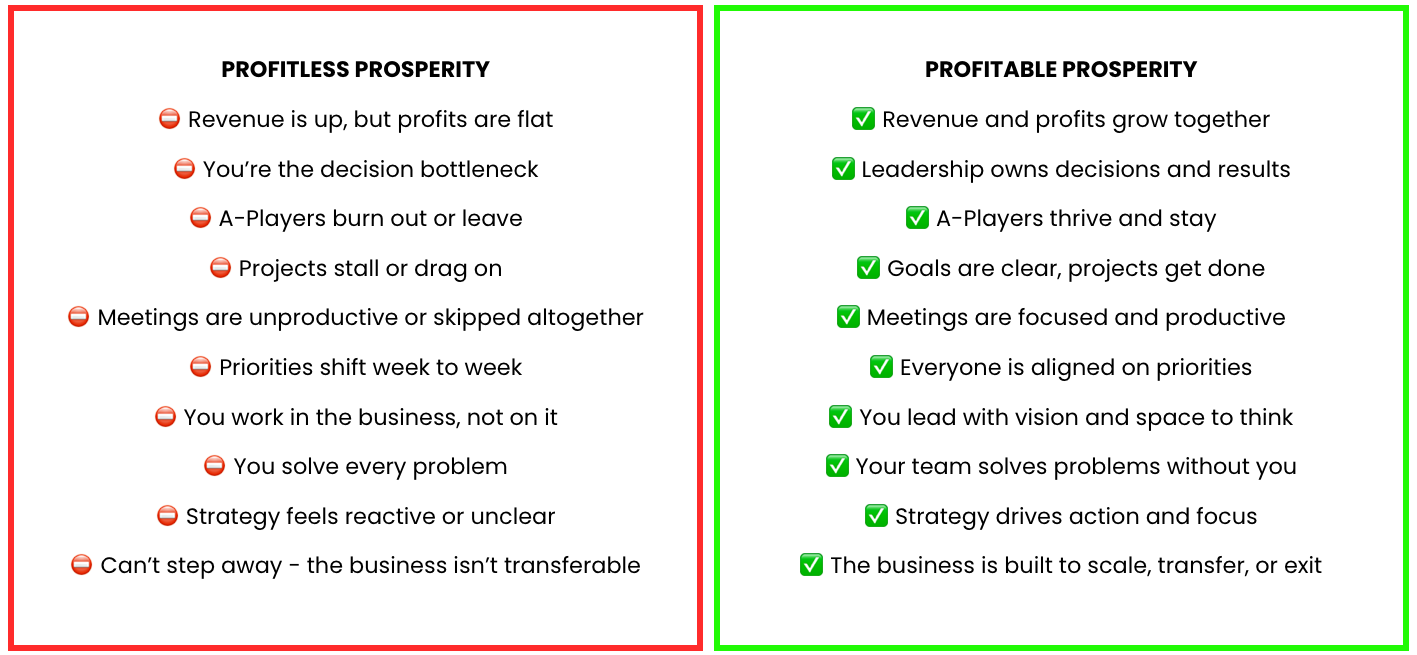
Not All Growth Is Good Growth
Growth is almost universally celebrated.
More revenue.
More scale.
More opportunity.
But growth, by itself, is neutral.
Some growth creates leverage.
Other growth creates dependence.
Some growth expands leadership capacity.
Other growth expands obligation.
From the outside, both can look identical.
Revenue rises. The team gets bigger. The business appears to be working.
And yet, many founders quietly experience something else.
More pressure than expected.
More decisions flowing back to them.
More responsibility concentrated at the top.
The business works.
But it depends on them working — constantly.
This is where the distinction matters.
Not all growth is good growth.
There is a version of success that looks prosperous but feels heavy. Revenue increases, but margins strain. The team is busy, but accountability drifts. Execution requires pushing. Stepping away feels risky because too much still runs through one person.
That condition is common. It’s also seductive.
It feels like progress.
But over time, it limits optionality.
Profitable Prosperity is different.
It is not a mindset.
It is not an aspiration.
It is an outcome.
It is what happens when a business is built in the right order — and protected with discipline over time.
In Profitable Prosperity:
Margins are healthy.
Leadership responsibility is shared.
Decisions are made consistently.
Execution holds without heroics.
The business functions without constant personal intervention.
Freedom is how it feels.
Optionality is how it works.
This shift doesn’t happen because the owner works harder. It happens because the business is built differently.
It begins with a decision.
A real decision — not an intention — that growth will no longer depend on constant personal intervention.
From there, everything follows in sequence.
Clarity comes first. Clear priorities. Clear definitions of success. Clear tradeoffs.
Then alignment. Leaders making decisions using the same logic. Protecting the same commitments under pressure.
Then disciplined execution. Single-point ownership. Rhythmic review. Accountability that does not shift when things get uncomfortable.
And finally, guidance. Because even strong systems drift. Standards must be reinforced over time, or they quietly erode.
When that sequence is honored, something changes.
The business begins to create space instead of consuming it.
Optionality expands.
You can grow — or choose not to.
You can invest — or hold steady.
You can step back — or lean in.
You can sell — or stay.
Not because you are exhausted.
Not because you are cornered.
But because you choose.
Revenue is a measure.
Profit is a measure.
Scale is a measure.
Optionality is evidence.
It is evidence that the business no longer depends on one person to hold it together.
It is evidence that leadership capacity has multiplied.
It is evidence that growth is strengthening the system — not straining it.
Profitable Prosperity is not about slowing down.
It is about building in a way that makes growth durable.
Because not all growth is good growth.
The question isn’t whether your business is growing.
The question is what that growth is creating.
Pressure — or space?
Dependence — or optionality?
Momentum — or durability?
Growth should create space.
If it doesn’t, it’s worth asking why.
Where This Pattern Appears
This distinction often becomes visible inside founder-led companies that have grown successfully but have not yet fully translated growth into operating clarity. Revenue increases, the team expands, and the business remains active, yet more decisions begin flowing back toward the founder.
From the outside the organization appears prosperous. Internally, however, leadership capacity becomes constrained, coordination requires more effort, and stepping away feels increasingly difficult. Over time this quiet dependence begins shaping the ownership structure of the business itself.
A Simple Place to Start
If this distinction feels familiar inside your organization, it can be useful to step back and evaluate how clarity, alignment, and execution currently function across the leadership team.
A simple starting point is the Baseline Business Assessment, a short diagnostic designed to help leadership teams identify whether growth is creating greater leadership capacity — or quietly increasing dependence on the founder.