
Growth Isn't the Goal — Business Health Is
Why does growth sometimes make a business less healthy?
It's a question I've found myself thinking about more often over the past few years.
For much of my career, I viewed growth the same way most business owners do. More revenue, more customers, more employees, and a growing backlog all seemed like obvious signs that a business was moving in the right direction. They are certainly signs of growth, and every healthy business should aspire to grow. What I've come to appreciate, however, is that growth and business health are not always the same thing.
I've never met a founder who set out to build a business that depended on them more every year. Yet I've met many who unintentionally did.
That's not because growth is the problem. Growth is generally a good thing. The problem is that growth has an uncanny ability to amplify whatever already exists inside a business. Healthy leadership teams tend to become stronger as they grow. Businesses with unclear priorities, weak accountability, or founders who remain the decision bottleneck often become more dependent on those same behaviors. Growth doesn't create organizational weaknesses nearly as often as it exposes them.
Profitless Prosperity vs. Profitable Prosperity
A while back, I came across the phrase Profitless Prosperity. I don't know who coined it, but it immediately resonated because it described something I've observed throughout my career. From the outside, these businesses often look incredibly successful. Inside, however, the owner feels more responsible than ever, the leadership team struggles to keep pace, and the business becomes increasingly difficult to lead. The company gets bigger, but it doesn't necessarily become healthier.
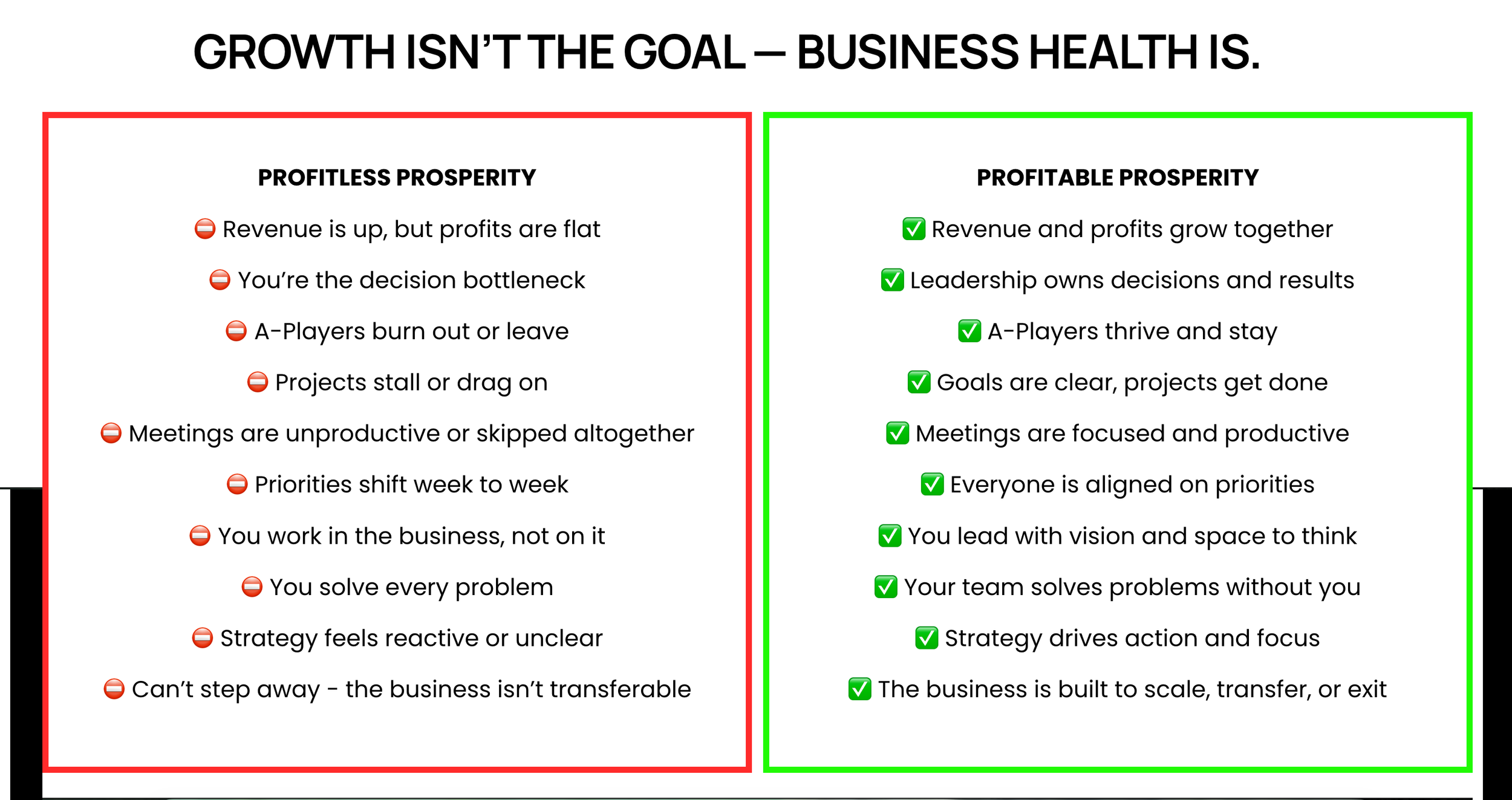
In Profitless Prosperity, revenue climbs but profits stay flat. The founder remains the decision bottleneck. A-players burn out or leave. Projects stall, meetings drag, and priorities shift week to week. The founder works in the business instead of on it — solving every problem instead of building a team that can.
Profitable Prosperity looks different. Revenue and profit grow together. Leadership owns decisions and results. A-players thrive and stay. Goals are clear, meetings are focused, and the whole team is aligned on priorities. The founder leads with vision and space to think, while the team solves problems without them. Strategy drives action instead of reacting to it — and the business becomes something that can scale, transfer, or exit.
Asking a Different Question
That realization has changed the way I think about growth. Today, I find myself asking a different question. Not simply, "Is the business growing?" but, "Is the business becoming healthier?" Is the leadership team growing? Are decisions being made closer to where the work happens? Is accountability improving? Is the business becoming more valuable, more resilient, and giving the owner more choices — not fewer?
The founders I know didn't start their businesses simply to become busier. They started them to create opportunity — for their families, their employees, their customers, and ultimately themselves. That's why I've become convinced we should spend less time asking whether a business is getting bigger and more time asking whether it's becoming healthier.
Growth matters. It always will.
But if growth isn't producing a healthier business, it's worth asking what it's really producing.
Curious where your business really stands? The Baseline Business Assessment gives you a clear, honest read on whether your growth is building a healthier business or just a bigger one. If you're ready to find out,take the free Baseline Business Assessment.