
When Missed Goals Become Accepted Behavior
A missed goal is an event. Repeatedly accepting missed goals without changing anything creates a standard.
“And then the day came, when the risk to remain tight in a bud was more painful than the risk it took to blossom.” [Elizabeth Appell, Risk]
Elizabeth Appell's short poem is often treated as an observation about personal growth. It is also a useful way to think about leadership teams. Change carries risk. It creates uncertainty, exposes disagreement and demands different behavior. Remaining where we are can feel safer - even when the results tell us otherwise.
That is especially true when a leadership team repeatedly misses its most important goals. Everyone may agree that accountability must improve. Everyone may genuinely intend to do better next quarter. Yet the same goals continue to move from one quarter to the next, accompanied by reasonable explanations and renewed promises.
At some point, a missed goal stops being an isolated event. It becomes accepted behavior.
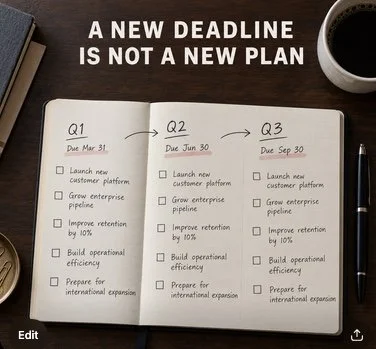
A missed goal is not the problem
No serious leadership team achieves every goal exactly as planned. Conditions change. New information emerges. A major customer leaves, a key employee resigns or an opportunity requires the company to redirect resources. A missed goal can be the result of a sound decision.
The real problem begins when the team accepts the miss without creating clarity about what happened and what must change. The deadline moves, but the plan does not. The owner remains the same, the obstacles remain unresolved and the team makes essentially the same commitment again.
The explanation may be legitimate. But when an explanation replaces corrective action, it quietly becomes permission.
The stated standard and the actual standard
Leadership teams communicate standards in two ways. They state what matters, and they demonstrate what is truly required. The second message is always stronger.
A company can say that commitments matter. It can place goals on a scoreboard, review them in meetings and discuss accountability as a core expectation. But if important goals are repeatedly missed without learning, adjustment or consequence, the organization receives a different message: commitments are negotiable.
I often remind leaders, "You endorse what you accept." That does not mean every miss deserves blame or punishment. It means that what leaders repeatedly tolerate eventually defines the real operating standard.
Other members of the leadership team notice. Strong performers begin questioning why they continue stretching to meet their commitments when others do not. Meetings become reporting exercises instead of decision-making forums. Goals lose credibility. Eventually, a team may still use the language of accountability while practicing accommodation.
Accountability is not blame
The word accountability can sound punitive, particularly when a goal has already been missed. Used well, however, accountability is not about finding someone to blame. It is about ensuring that a missed commitment produces greater clarity, useful learning and corrective action.
A leadership team practicing healthy accountability should be able to answer several direct questions. What happened? What did we learn? What must change? Who owns that change? By when? What will make the next outcome different?
These questions help distinguish an understandable miss from an emerging pattern. They may reveal that the goal was unclear, ownership was divided, priorities changed, resources were insufficient or the team never truly aligned around the commitment. They may also reveal that someone needs additional guidance, a different role or a more candid conversation about performance.
Accountability does not predetermine the answer. It prevents the team from accepting the same answer indefinitely.
Change before the pain forces it
A familiar leadership maxim says that change happens when the pain of staying the same becomes greater than the pain of change. That may describe how many organizations finally act, but strong leadership teams should not need to wait for the pain to become unbearable.
With the right visibility and guidance, leaders can see the accumulating cost earlier. Missed goals delay important initiatives, consume leadership capacity, weaken trust and create uncertainty throughout the organization. The cost rarely arrives all at once. It compounds quietly.
This is why meaningful execution begins with a decision. The team decides that recurring misses will no longer be treated as normal. That decision creates the clarity to define the commitment and its owner, the alignment to support it and the discipline to execute. When something does not go as planned, the same discipline turns the miss into learning and action rather than another explanation.
The goal is not a culture where failure is feared. It is a culture where commitments matter, obstacles are addressed honestly and missed goals lead to something different.
Every leadership team will miss a goal. The more important question is what the team allows to happen next.
Ready to see where your business really stands? Take the free Baseline Business Assessment to help identify the pain.
Source note
The poem Risk is widely misattributed to Anais Nin. Elizabeth Appell states that she wrote it in 1979 under the name Lassie Benton for an adult-education brochure at John F. Kennedy University. See readelizabeth.com and anaisnin.org.